
February 26, 1943 entry Item Info
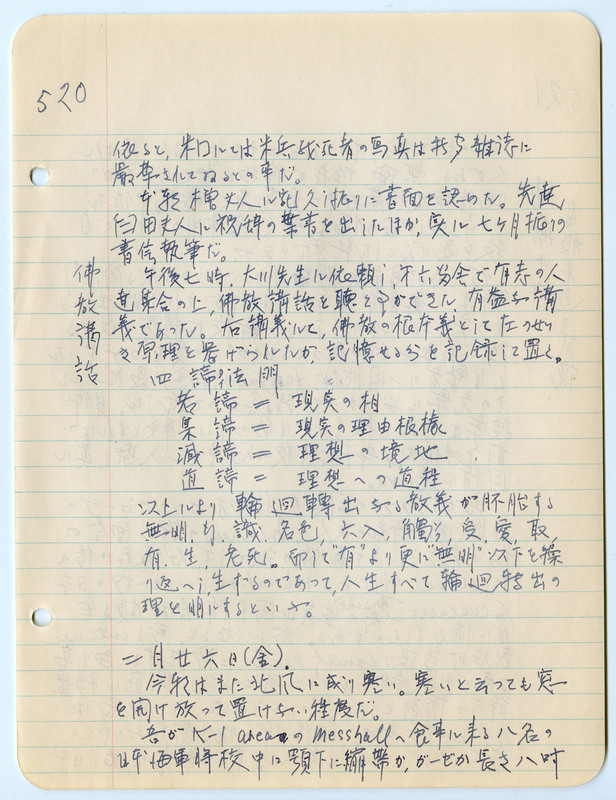
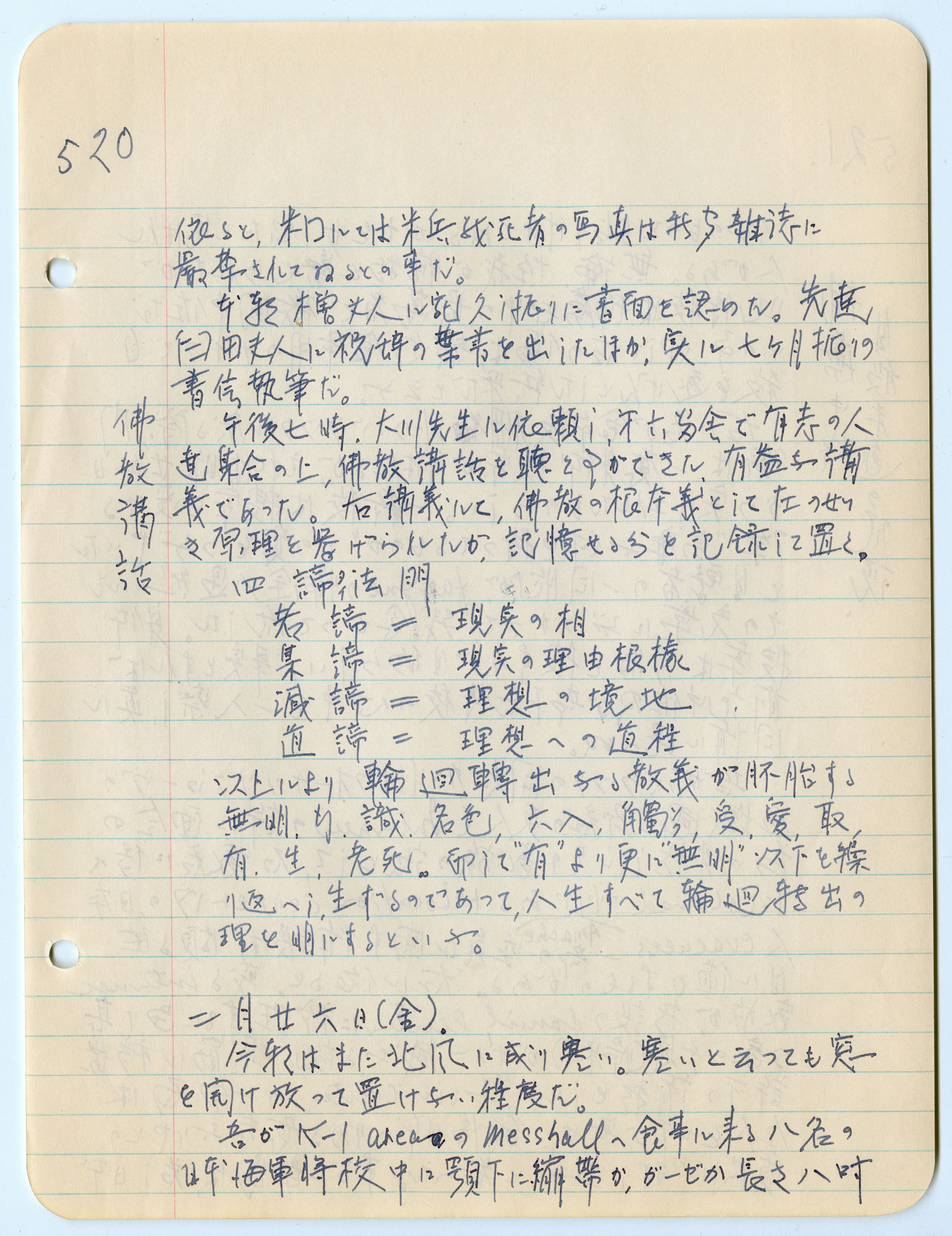
February 26 (Friday)
It is cold again tonight with the northern wild coming back. It is just chilly enough to have to keep the windows closed.
There is one officer, seemingly little over 40, wearing about nine-inches long gauze dressing as a bandage under his chin among the eight Japanese navy officers who come to the mess hall in our K-1 Area for their meals.
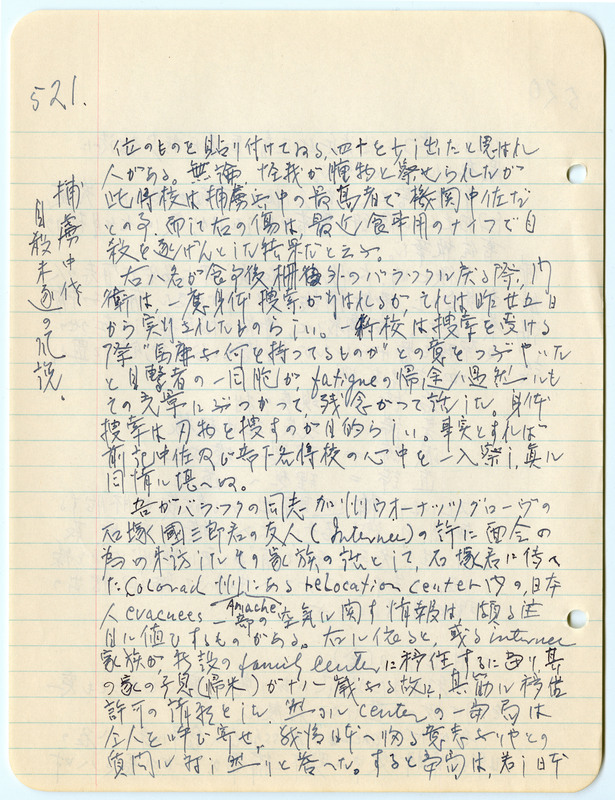
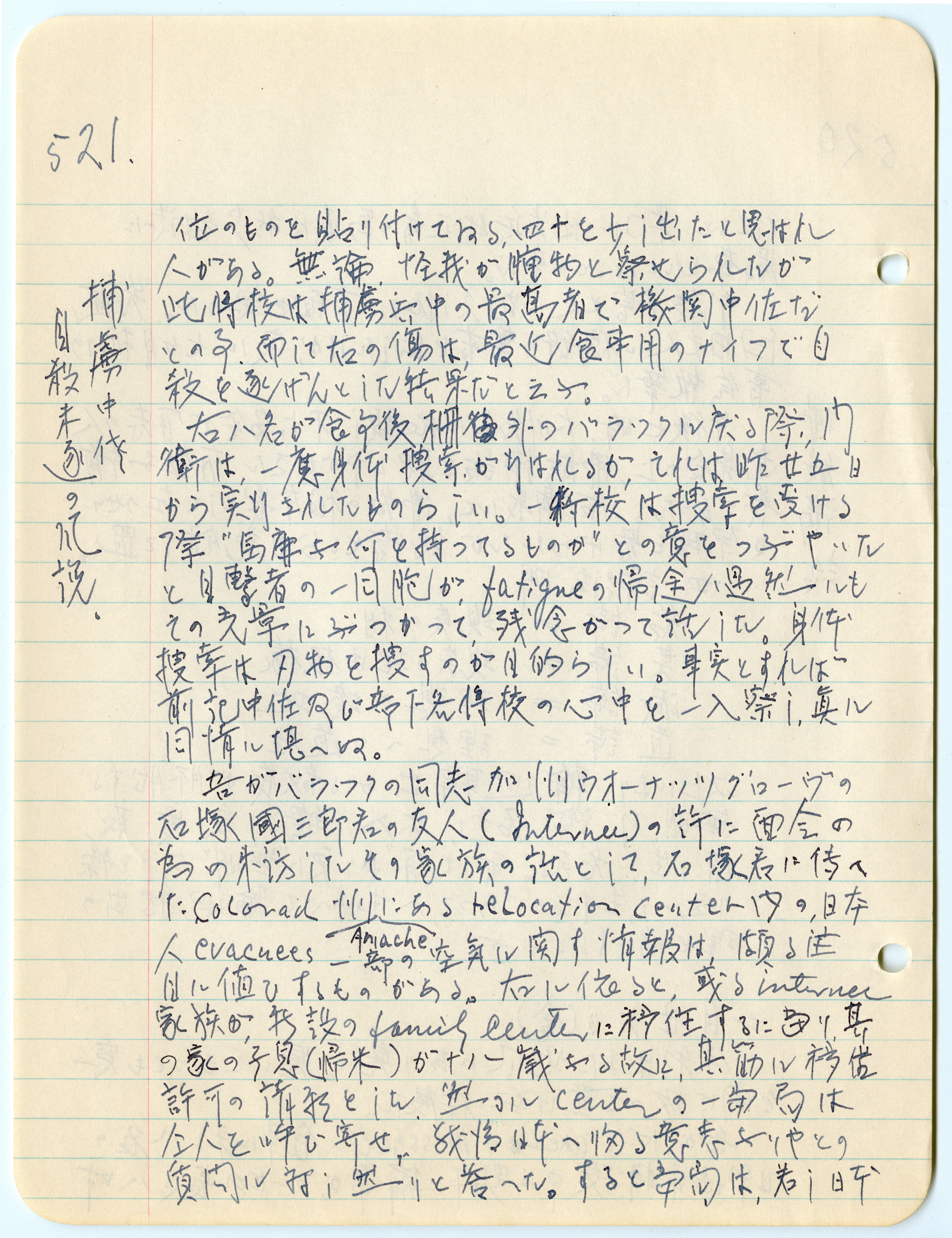
521
I thought it was naturally some type of injury or swelling and heard that he is the oldest of the prisoners of war and is an engineer Lieutenant Colonel. It is said that his injury is the result of his suicide attempt using a dinner knife.
The gate guards conduct a body check when the eight soldiers return to their barracks outside the fence, and I heard that it started on the 25th. One of the fellow citizens here happened to see it on the way back when one of the officers was being checked. He told us with frustration that the officer muttered, “This is silly. How do I get to have anything?’ The purpose of the body check is supposed to find concealed knives. If this is true, I feel very sorry for the Lieutenant Colonel and the other officers, imagining how they are feeling.
Mr. Kunisaburo Ishizuka from Walnut Grove in California told us about what his friend (internee) heard from his family regarding the relocation center [1] in Amacha, Colorado. It is about how a part of the evacuees [2] feel, and I think it deserves our attention. One internee family is scheduled to be transferred to the new family center. Their son (kibei)[3] is turning 18 and applied for a transfer permission to the administration. The center administration met with him and asked him if he is intending to return to Japan. He answered yes.
522
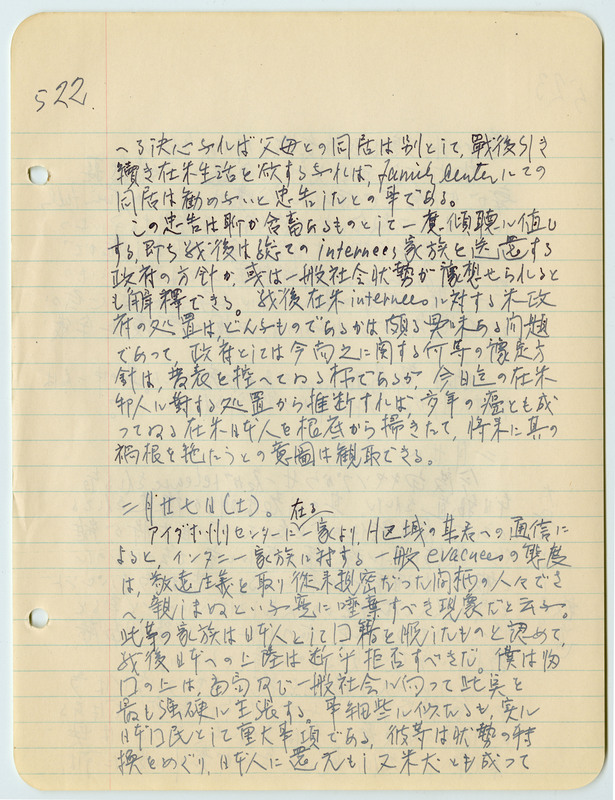
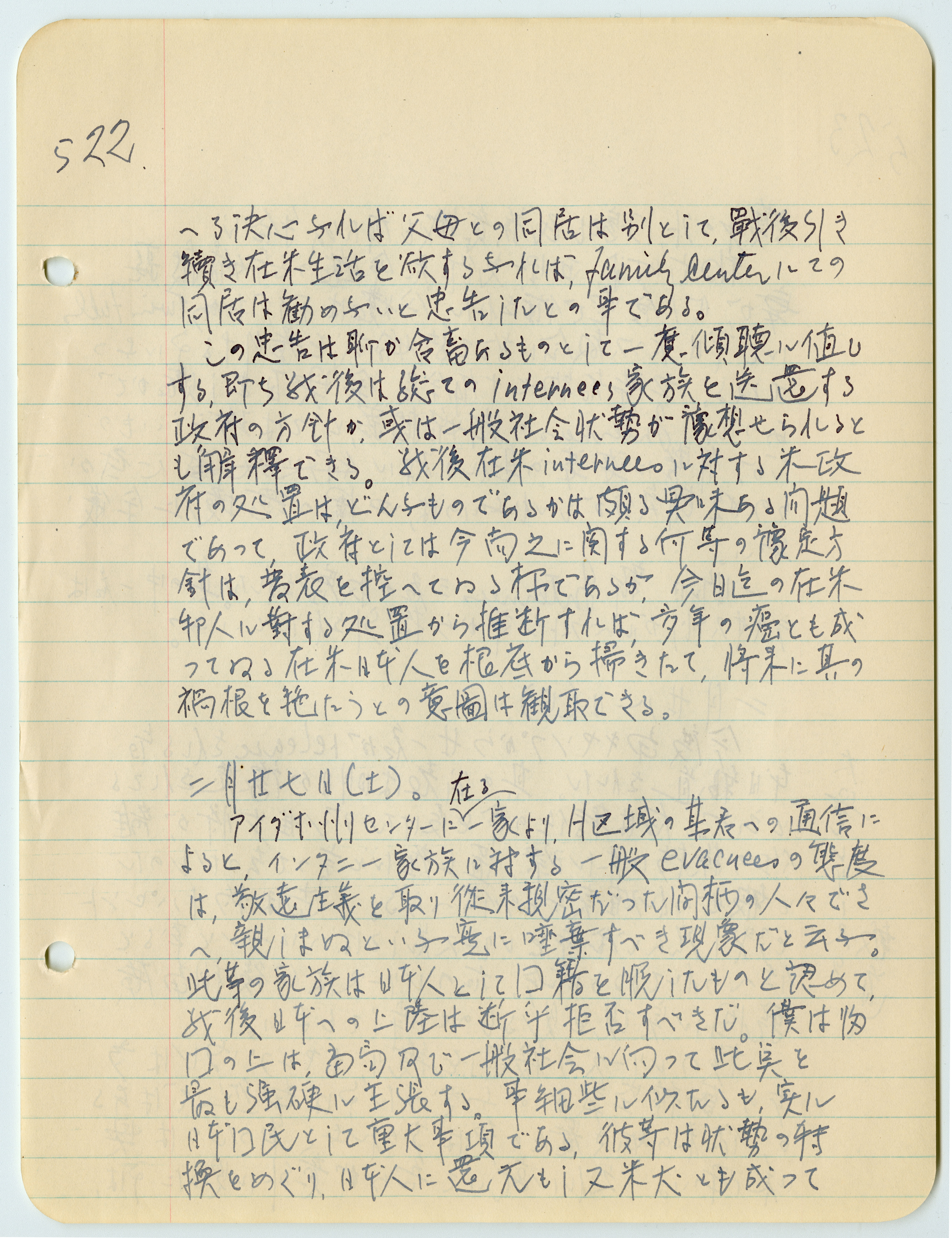
The administration told him that he could live with his parents if he would like to return, but they would recommend against living with his parents in the family center if he would like to continue to live in the U.S. after the war.
I think the advice has some implications and is worth listening to. It could indicate a government policy to send all the internees and their families back to Japan, it can be interpreted that the public society would demand such a policy. It is highly interesting to see how the U.S. government will treat the internees after the war, and it seems that they are avoiding making any policy announcements of their future plans. However, Japanese residing in the U.S. have been a cancer for the nation for a number of years. Judging from how the government has treated us, I observe their intention to uproot, sweep up and annihilate us in the future.
[1] This is the term used by the author
[2] This is the term used by the author
[3] Japanese American who was born in the U.S., educated in Japan, and returned to the U.S.
- Title:
- February 26, 1943 entry
- Creator:
- Sakaino, Bunro
- Date Created (ISO Standard):
- 1943-02-26
- Description:
- February 26, 1943, diary entry written by Bunro Sakaino while he was incarcerated at Camp Livingston, near Pineville, Louisiana.
- Subjects:
- concentration camps diaries
- Location:
- Camp Livingston, LA
- Source:
- MG 387, George Shihei Shitamae papers, Special Collections and Archives, University of Idaho Library
- Translator:
- Transcribed and translated by Naoko Tanabe, 2024-2025, of Densho (densho.org)
- Source Identifier:
- mg387_1_7-1943-02-26
- Type:
- Text
- Format:
- application/pdf
- Language:
- jpn
U of I Digital Collections contain unique digitized and born digital archival materials in a variety of formats. The Library is committed to ensuring our resources are accessible to all users. Please contact us if you need support accessing or using this archived content.
Contact us about this record Library Help- Citation:
- "February 26, 1943 entry", Bunro Sakaino Concentration Camp Diary, University of Idaho Library Digital Collections, https://www.lib.uidaho.edu/digital/sakaino/items/sakaino450.html
- Rights:
- In copyright, educational use permitted. Educational use includes non-commercial reproduction of text and images in materials for teaching and research purposes. For other contexts beyond fair use, including digital reproduction, please contact the University of Idaho Library Special Collections and Archives Department at libspec@uidaho.edu. The University of Idaho Library is not liable for any violations of the law by users.
- Standardized Rights:
- http://rightsstatements.org/vocab/InC-EDU/1.0/