
About Web Archive Collections
The University of Idaho website is an important part of the institution’s scholarly and cultural record, serving as a central place for communication and publishing unique materials. This content is constantly changing with new updates, edits, and redesigns–reflecting the continual evolution of the institution.
As part of Special Collections and Archives work to preserve primary sources that document the history the university, the Library proactively captures unique born-digital content published on websites to ensure continued access and preservation. We use tools such as Archive-It, Perma.cc, ArchiveWeb.page, and wget. The content we preserve is made available as part of larger web archives and select digital collections.
If you regularly archive web pages to cite in your research, please check out the Library’s Perma.cc Service.
Accessing Web Archives
To find old University of Idaho web pages, the most complete collection is available via the Internet Archive Wayback Machine. Visit the Wayback Machine and paste in a current or broken link to see if it has been captured. The Wayback system retrieves verifiable copies and presents the page as it was at the time of capture. Clicking navigation links on archived web pages will redirect to archived copies if available allowing you to explore the website at that time.
University of Idaho content is regularly harvested by Internet Archive crawlers, curated harvests administered by the Library, other collecting institutions, and single page captures initiated by public users. All these sources are accessible via the Wayback Machine. Visit the archive for www.uidaho.edu to explore the full list of captures.
Check our How to Use Web Archives page for more details and don’t hesitate to get in touch with Special Collections & Archives for help.
Why Web Archive?
Content on the web is in constant flux: rapidly appearing, updating, and disappearing.
In some cases these are intentionally time-limited, spontaneous, or ephemeral cultural artifacts that may still hold enduring value and relevance to the historical record. Others are seemingly stable pages which through a gradual process of theme, data, and platform updates become inadvertently broken or altered.
As the web becomes the primary means of disseminating information this flux can have negative impacts on the sustainability of historical sources and citations. For example, a survey of journal articles in 2015 found that:
“Over 50% of cited links in Supreme Court opinions no longer point to the intended page. Roughly 70% of cited links in academic legal journals and 20% of all science, technology and medicine articles suffer from link rot.” (Perma.cc)
Web links suffer from two main issues:
- Link Rot – when a given link breaks, pointing to nothing or the wrong page.
- Reference Rot / Content Drift – when content on page at a given link has changed, no longer matching the original citation.
About Web Archives
For decades libraries and archives around the world have been working on the challenge of preserving web resources for current and future generations. As with all digital information, it is at-risk without active digital preservation measures (see Why Digital Preservation is Important for Everyone (2010)).
For example, the U of I Library Web History Timeline highlights the major redesigns over the last two decades as captured by the Internet Archive.
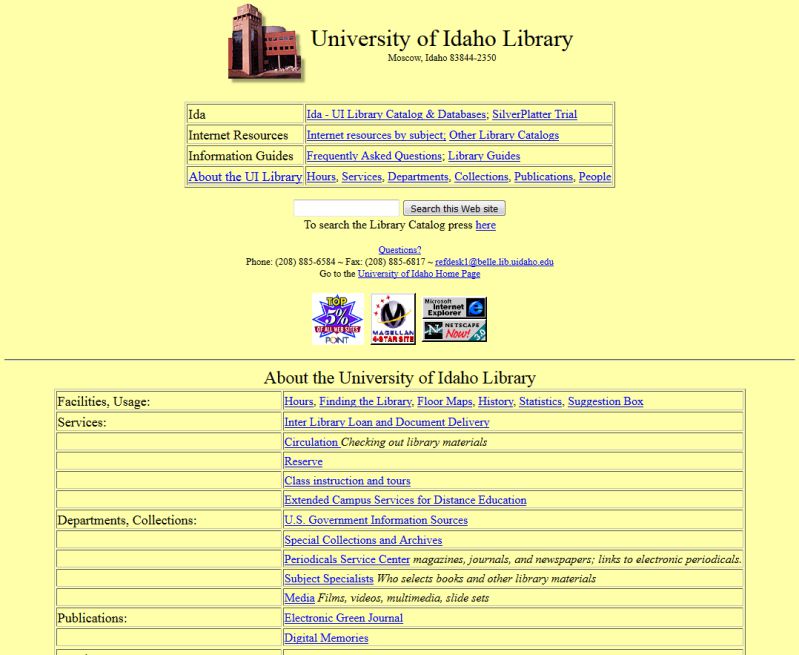
To provide authentic access to archived web content, the Wayback Machine renders the original functionality in the user’s web browser with hyperlinks automatically redirected to archived sources rather than the live web.
Keep in mind that some web resources are difficult to capture, will display anomalies when removed from the live web, or intentionally prevent archiving. Social media streams, paywalled resources, streaming videos, and 3rd party embeds are unlikely to be correctly captured.
The Internet Archive has been leading the field of web archiving since 1996, developing the technical means to harvest, store, preserve, and access archived web content on a huge scale. In 2003 they helped form the International Internet Preservation Consortium (IIPC) to support collaborative efforts to improve standards, tools, and best practices for web archiving.